Subterranean termites require continuous contact with ground moisture, nesting deep in Central Florida sandy soils before constructing earthen shelter tubes over masonry to reach wood framing. The humid wetlands…
Subterranean termites require continuous contact with ground moisture, nesting deep in Central Florida sandy soils before constructing earthen shelter tubes over masonry to reach wood framing. The humid wetlands flanking Lake Tohopekaliga create prime soil conditions for eastern subterranean termites (*Reticulitermes flavipes*), which exploit plumbing penetrations in concrete slabs across Poinciana, Buenaventura Lakes (BVL), and Bellalago. High water tables near Kissimmee Lakefront Park accelerate colony feeding rates during warm summer rain cycles. Left unaddressed, a mature colony containing over 300,000 workers can consume approximately one linear foot of pine framing lumber every six months.
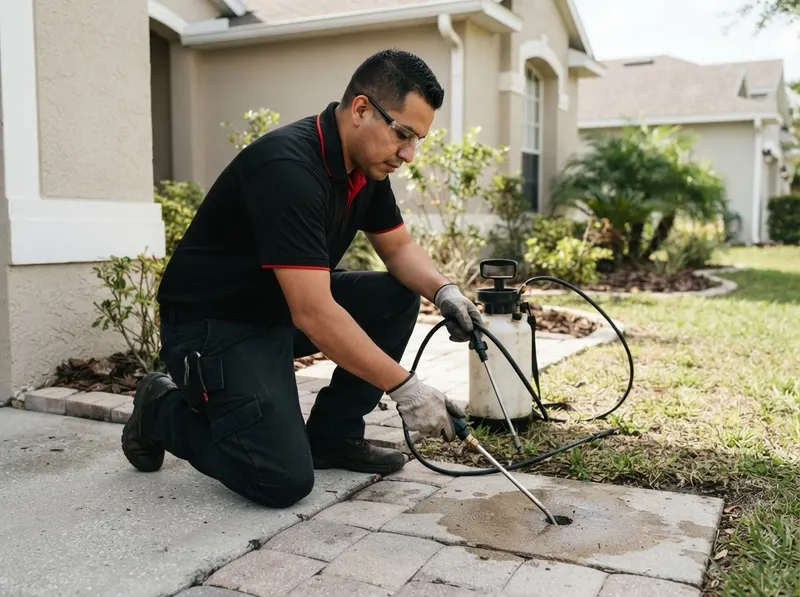
Effective management relies on two primary protocols: non-repellent liquid soil barriers or bait station networks. Liquid treatments involve digging a 6-inch trench along the perimeter stem wall, rodding down to footer level, and applying a long-residual termiticide. Foraging termites unknowingly cross this barrier, transfer the active agent to the nest via grooming, and collapse the queen colony. In-ground bait stations serve as an alternate or companion approach around properties near sensitive retention ponds or extensive hardscaping in Celebration, Tapestry, and Flora Ridge, utilizing insect growth regulators that disrupt subterranean molting cycles.
Choosing between liquid barriers and bait systems comes down to soil moisture and physical exterior design. Liquid trenching provides immediate defensive protection against active interior infestations, but requires uninterrupted soil access around the foundation perimeter. If expansive paver patios, concrete pool decks, or adjacent wetlands border homes in Solivita or Mill Run, drilling expansion slabs or opting for perimeter bait stations provides thorough interception without structural alterations. Treatment does not require vacating the property for days, and interior spot applications use low-toxicity products applied directly into wall voids rather than open living spaces.
Every job gets a firm, written price after a free on-site visit.
Tell us about your subterranean termite treatment job in Kissimmee and we'll send a clear, written quote, usually the same day.
 Copper Kettle Pest Control